NDT Testing
Visual inspection tells you a lot about the surface of a weld. It tells you nothing about what is inside a complete-joint-penetration groove weld. That is what nondestructive testing is for.
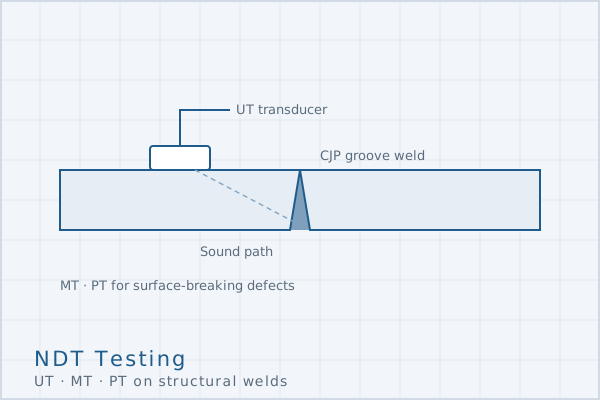
Methods
Ultrasonic testing (UT)
Sound waves sent through the weld reveal internal discontinuities — lack of fusion, slag, porosity and cracking — that are invisible from the surface. UT is the method most commonly required for complete-joint-penetration groove welds in moment frames, braced frames and other primary connections.
Magnetic particle testing (MT)
A magnetic field and iron particles show cracks and other defects at or just below the surface of steel. It is commonly used on fillet welds, root passes, back-gouged surfaces and repairs.
Dye penetrant testing (PT)
A visible dye drawn into surface-breaking defects and then developed makes fine cracks easy to see. It works on non-magnetic materials as well as steel, and where MT is not practical.
When testing is required
The statement of special inspections and the project specifications set which welds are tested and how often. Common triggers are UT of complete-joint-penetration groove welds under AISC 360 Chapter N, and the additional testing AISC 341 requires on seismic force-resisting systems. We confirm the required scope and frequency with the engineer of record before testing starts.
Who performs the testing
NDT is performed by technicians qualified for the method used, as AWS D1.1 requires — BK’s own technicians or a certified testing partner, depending on the method and the job. Either way, the results come back through BK and into the same record as the visual weld inspection, so the engineer and the building official review one set of documents.
Rejected welds
Rejected welds are reported the same day with joint ID, location and the type and extent of the indication. The contractor repairs them as directed by the engineer of record, and we retest the repaired weld before it is accepted.
Common questions
Do you test shop welds as well as field welds?
Contact us with the project scope. Field welds are tested on site; shop testing at a fabricator depends on location and on whether the fabricator is approved, and we scope it case by case.
What does a UT report include?
Joint identification, weld type and thickness, the procedure and acceptance criteria used, each indication found with its location and rating, and an accept or reject result for every weld tested.
Method and deliverables
| Methods | Ultrasonic (UT), magnetic particle (MT), dye penetrant (PT) |
|---|---|
| Code basis | IBC / CBC 1705.2; AISC 360 Chapter N; AISC 341 Chapter J |
| Referenced standards | AWS D1.1; ASTM E164, E709, E165 |
| Deliverables | Test reports by joint, reject log, retest records |
Need an inspector on site this week?
Send the plan set, the statement of special inspections, and the jurisdiction. We will come back with scope and pricing — not a form to fill out.