Bolting & Welding Special Inspection
Steel connections are inspected while they are being made or not at all. Once the fireproofing goes on, the weld is a matter of record, not observation.
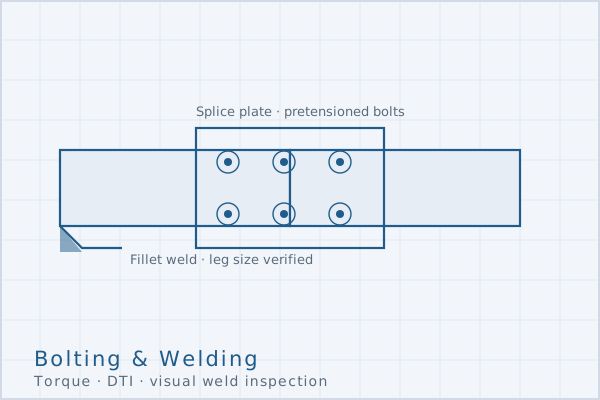
Welding inspection
Visual inspection of structural welds is performed to AWS D1.1 and AISC 360 Chapter N. Inspection is not limited to the finished weld — the conditions that determine weld quality are set before the arc is struck.
- Welding procedure specifications (WPS) reviewed and available at the work
- Welder qualification records current for the process, position and material
- Base metal condition, fit-up, root opening and joint preparation
- Preheat and interpass temperature where required by the WPS
- Consumable identification, condition and storage
- In-process observation of root and intermediate passes
- Visual acceptance of completed welds — size, profile, undercut, porosity, cracks, arc strikes
- Coordination of non-destructive testing where UT, MT or PT is specified
High-strength bolting
Bolted connection inspection follows the RCSC Specification for Structural Joints Using High-Strength Bolts and AISC 360 Chapter N. The required inspection depends on the joint type — snug-tight, pretensioned or slip-critical — and on the installation method selected by the erector.
- Fastener assembly identification, condition, storage and lubrication
- Rotational capacity testing of fastener assemblies where required
- Faying surface condition and preparation for slip-critical joints
- Pre-installation verification testing in a tension calibrator at the start of work
- Installation method verification — turn-of-nut, calibrated wrench, DTI or twist-off
- Direct tension indicator gap verification with feeler gauges
- Snug-tight condition and bolt pattern completeness before pretensioning
- Ply gaps, hole condition and washer requirements
Common questions
Do you perform ultrasonic testing?
We perform visual weld inspection and coordinate ultrasonic, magnetic particle and dye penetrant testing with a qualified NDT provider where the project requires it, then incorporate those results into the special inspection record.
What is pre-installation verification testing?
Before pretensioned bolting begins, a representative sample of the actual fastener assemblies is tested in a tension calibrator to confirm the installation method will develop the required pretension with the bolts, nuts, washers and lubrication actually on the job. It is required by the RCSC Specification and it is one of the most frequently skipped steps in the field.
Code basis and deliverables
| Code basis | IBC / CBC Chapter 17, Section 1705.2; AISC 360 Chapter N |
|---|---|
| Referenced standards | AWS D1.1 / D1.4 / D1.8; RCSC Specification for Structural Joints; ASTM F3125 |
| Inspection level | Continuous for complete joint penetration welds and pretensioned bolting; periodic for fillet welds and snug-tight joints, per the statement of special inspections |
| Deliverables | Weld inspection reports, bolting verification logs, DTI and torque records, NDT coordination records |
Need an inspector on site this week?
Send the plan set, the statement of special inspections, and the jurisdiction. We will come back with scope and pricing — not a form to fill out.