Firestopping Special Inspection
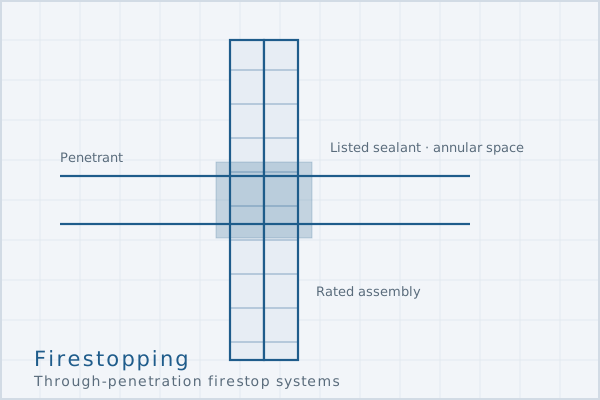
A firestop system is only rated as a complete assembly. Substitute one component — the fill depth, the sleeve, the annular space — and the listing is void, whether or not it was ever inspected.
Inspection
We inspect through-penetration firestop systems and fire resistive joint systems against the specific listed system — UL, FM or other approved listing — assigned to each condition. A firestop system is only rated as a complete assembly: the penetrant, the wall or floor construction, the annular space, the fill material and the depth all have to match the listing. Substituting any one of them voids it, and this is where most deficiencies come from.
- Listed system identification for each penetration and joint condition
- Penetrant type, size and location within the opening
- Annular space dimensions against the listed minimum and maximum
- Fill material product identification, depth and continuity
- Packing and backing material type and compression
- Sleeve installation and projection where sleeves are part of the listing
- Joint width, movement capability and installation at head of wall conditions
- Labeling and documentation of completed penetrations
Destructive sampling on enclosed work
When firestopping has already been covered before it could be inspected, ASTM E2174 provides for destructive sampling — opening a defined percentage of concealed penetrations to verify the population. The sampling percentage is not something we assume. We coordinate it with the authority having jurisdiction and the engineer of record in writing before any opening is made, then document each opened location, the condition found, and the restoration.
- Sampling percentage agreed with the AHJ in writing before work begins
- Each opened location photographed and logged
- Expanded sampling where the initial sample shows non-conformance
- Openings restored to the listed assembly rating
Deficiency reporting
Where firestopping does not match its listed assembly, we document it as a non-conformance with location, the listed system it was supposed to meet, and the specific way it deviates — short fill depth, wrong sealant, missing sleeve, oversized annular space. That report goes to the contractor and the building official the same day, and the location stays open in our log until it is corrected and we re-inspect it. We report and verify the fix; the correction itself is performed by the contractor responsible for that scope.
Common questions
Our firestopping is already covered up. What are our options?
Destructive sampling under ASTM E2174. A percentage of concealed penetrations is opened and verified, the sample expands if deficiencies are found, and openings are restored. The percentage is set with the building official — we get that agreement in writing before opening anything so the result is not disputed.
Do you work on federal and prevailing wage projects?
Yes. We have performed firestopping inspection on federal, state, and municipal projects, including work for the U.S. Navy, and are familiar with the Contracting Officer notification and non-conformance reporting those contracts require.
Code basis and deliverables
| Code basis | IBC / CBC 1705.17; CBC Section 714 for penetrations and 715 for joints |
|---|---|
| Referenced standards | ASTM E2174 (penetrations), ASTM E2393 (joints), ASTM E814 / UL 1479, UL 2079 |
| Inspection level | Per the statement of special inspections; commonly required on high-rise and Type I and II construction |
| Deliverables | Penetration logs by location and listed system, photographic documentation, non-conformance reports, re-inspection records |
Need an inspector on site this week?
Send the plan set, the statement of special inspections, and the jurisdiction. We will come back with scope and pricing — not a form to fill out.