Epoxy Anchors Special Inspection
Adhesive anchors are the single most installation-sensitive connection on most jobs. A hole that was never brushed will hold on the day it is set and let go under load.
What we inspect
We provide special inspection of post-installed adhesive anchors and drilled-in rebar dowels, verified against the ICC-ES evaluation report (ESR) for the specific adhesive being used and against the manufacturer's printed installation instructions. The ESR is the controlling document — anchor capacity is only valid within the conditions that report was tested under, and most field problems trace back to a deviation from it.
- Base material condition, thickness, and concrete age at time of installation
- Hole diameter, depth, drilling method and hole condition, including dry versus water-saturated
- Hole cleaning sequence — blow, brush, blow — with the brush size the ESR requires
- Adhesive lot number, expiration date, storage and mixing nozzle use
- Discard length dispensed before the first anchor
- Anchor embedment depth, edge distance, spacing and orientation
- Full cure time observed before any load is applied
- Installer qualification where the anchor is horizontal or upwardly inclined and resisting sustained tension
Proof load testing
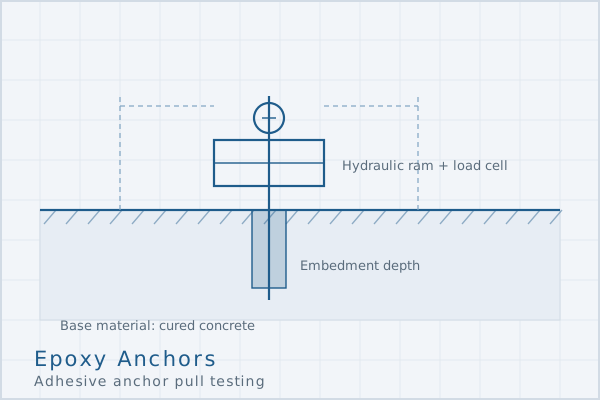
Where the engineer of record or the building official requires proof testing, we perform it with calibrated hydraulic equipment and a documented reaction setup, holding the specified test load for the specified duration and recording displacement. Test loads, hold times and the number of anchors tested come from the project specification or the AHJ — we confirm those in writing before mobilizing rather than assuming a percentage.
- Calibrated ram and load cell with current calibration certificates
- Test load, hold duration and acceptance criteria confirmed in writing before testing
- Displacement recorded at each anchor
- Failed anchors documented, mapped, and tracked in our log until the responsible contractor corrects them and we re-inspect
Sustained tension applications
IBC 1705.1.1 sets additional requirements for adhesive anchors installed horizontally or upwardly inclined to resist sustained tension loads — overhead anchors, in plain terms. These require continuous special inspection and an installer certified through an approved program. We verify the installer's certification on site and confirm it covers the adhesive system actually in use.
Common questions
How many anchors have to be tested?
There is no single national number. The percentage is set by the structural engineer's specification or by the local building department. We confirm the required sample size with the engineer of record and the AHJ in writing before testing so the results are not challenged later.
What happens if an anchor fails the proof load?
The anchor is documented as non-conforming and the failure is reported the same day. Typical next steps are expanding the test sample around the failure to bracket the affected area, then the contractor corrects it on direction from the engineer of record. We do not decide or perform the fix — we document the condition and give the engineer what they need to direct it.
Code basis and deliverables
| Code basis | IBC / CBC 1705.1.1, Chapter 17; ACI 318 Chapter 17 |
|---|---|
| Referenced standards | ACI 355.4; ASTM E488 / E1512; the governing ICC-ES ESR |
| Inspection level | Continuous for sustained tension overhead anchors; otherwise per the statement of special inspections |
| Deliverables | Field reports, pull test logs with load and displacement, calibration certificates, non-conformance reports |
Need an inspector on site this week?
Send the plan set, the statement of special inspections, and the jurisdiction. We will come back with scope and pricing — not a form to fill out.